Ammonites
AmmoniteNot a Dinosaur

Photograph of the ammonite Asteroceras which lived during the Jurassic
Ammonites were ocean-dwelling relatives of squid and octopuses that lived for hundreds of millions of years before vanishing around the end of the Cretaceous Period, about 66 million years ago. They are best known for their coiled shells, which could range from simple spirals to strange, uncoiled shapes. These shells, often beautifully patterned, are among the most common and recognizable fossils found around the world.
While most disappeared during the mass extinction that also wiped out the non-avian dinosaurs, some evidence suggests a few species may have survived briefly into the earliest Paleogene - the geologic period that followed the Cretaceous - before disappearing completely.
Although their shells resembled those of modern shelled cephalopods, ammonites were actually closer relatives of squid, cuttlefish, and octopuses. Each animal lived in the last chamber of its shell, using the rest - divided by walls called septa - for buoyancy control. With over 10,000 species described, ammonites were incredibly diverse and play a key role for scientists today as index fossils, helping to date the rocks in which they are found.
While most disappeared during the mass extinction that also wiped out the non-avian dinosaurs, some evidence suggests a few species may have survived briefly into the earliest Paleogene - the geologic period that followed the Cretaceous - before disappearing completely.
Although their shells resembled those of modern shelled cephalopods, ammonites were actually closer relatives of squid, cuttlefish, and octopuses. Each animal lived in the last chamber of its shell, using the rest - divided by walls called septa - for buoyancy control. With over 10,000 species described, ammonites were incredibly diverse and play a key role for scientists today as index fossils, helping to date the rocks in which they are found.
Shell Structure and Function

Cross-section of an ammonite shell, showing the old chambers used for buoyancy; the animal itself lived only in the final, outermost chamber.

Polished ammonite shell showing intricate suture lines formed where the internal walls met the outer shell.
Ammonites built their shells in a series of chambers, collectively called the phragmocone. As the animal grew, it moved forward into a newly added chamber and sealed off the older ones behind it with thin walls called septa. Only the last and largest chamber – the body chamber – was occupied by the living animal at any time. A narrow tube known as the siphuncle ran through the chambers, allowing the ammonite to pump water in or out and control its buoyancy, much like a submarine rising and sinking in the sea.
The overall look of an ammonite's shell could vary a lot. In some species the outer coils wrapped tightly around and almost hid the earlier ones, while in others each coil remained exposed, giving the shell a more open appearance. Many shells also carried ribs, ridges, or spines, which helped protect the animal and now help scientists tell different species apart.
Perhaps most distinctive, though, were the intricate patterns called sutures, where the chamber walls joined the outer shell. These lines could be relatively simple in earlier ammonites, but later species developed much more complex sutures that looked almost like leaf veins or embroidery.
The overall look of an ammonite's shell could vary a lot. In some species the outer coils wrapped tightly around and almost hid the earlier ones, while in others each coil remained exposed, giving the shell a more open appearance. Many shells also carried ribs, ridges, or spines, which helped protect the animal and now help scientists tell different species apart.
Perhaps most distinctive, though, were the intricate patterns called sutures, where the chamber walls joined the outer shell. These lines could be relatively simple in earlier ammonites, but later species developed much more complex sutures that looked almost like leaf veins or embroidery.
Sexual Dimorphism
Ammonites also showed differences between males and females, a feature known as sexual dimorphism. In many species the females, called macroconchs, were noticeably larger than the males, or microconchs, probably because they needed extra body space to produce and carry eggs.For a long time these size differences were mistaken for separate species, which has made estimating the true number of ammonite species tricky. Even so, scientists have identified well over 10,000 species, and possibly twice that many, making ammonites one of the most diverse and successful groups of marine animals in Earth's history.
Range of Shapes & Sizes

Fossil of Titanites giganteus

Parapuzosia seppenradensis, the largest known ammonite, with a diameter of 1.8m

Fossil shell of Polyptychoceras

Fossils of Nipponites mirabilis in the National Museum of Nature and Science, Tokyo.
Ammonites came in a wide range of shapes and sizes. Some species measured only a few millimetres across, while the largest, such as Parapuzosia seppenradensis from the Late Cretaceous, could have grown to over 2.5 metres in diameter - bigger than a person.
Examples of Ammonite Diversity
- Titanites giganteus – A large ammonite from the Late Jurassic (about 150 million years ago) of Europe, especially England, with shell diameters reaching around 60cm.
- Parapuzosia seppenradensis – Found in Late Cretaceous deposits of Germany, this is one of the largest ammonites ever discovered, with a shell diameter of nearly 2.6 meters. Its immense size suggests it occupied a unique ecological niche, possibly as a slow-moving, deep-water dweller. The fossil record shows only a few specimens, emphasizing its rarity.
- Baculites compressus – A straight-shelled ammonite from the Late Cretaceous of North America. Unlike the coiled shells most people associate with ammonites, Baculites grew in elongated, uncoiled shells resembling slender cigars.
- Polyptychoceras pseudogaultinum – A heteromorph ammonite from the Late Cretaceous of Japan. Its shell extended into a long, straight shaft that bent back on itself in a tight U, creating the "paperclip" form.
- Scaphites whitfieldi – Common in the Late Cretaceous Western Interior Seaway of North America. Its shell began in a normal coil, then curved away into a hook before curling slightly back toward the body.
- Nipponites mirabilis – A bizarre heteromorph ammonite from the Late Cretaceous of Japan. Its shell looks like a tangled ball of squiggly coils, apparently without order, yet functionally stable.
- Crioceratites nolani – From the Early Cretaceous of Europe. Its shell formed an open, loosely coiled spiral, almost spring-like in appearance.
- Oxynoticeras simpsoni – A small ammonite from the Early Jurassic of Europe. Its compressed, discoidal shell with a sharp keel suggests a hydrodynamic form suited for active swimming in open waters.
Legends and Myths
In the Middle Ages, people often believed ammonite fossils were the remains of snakes turned to stone, earning them the nickname "snakestones" or "serpentstones." Linked with saints such as Hilda of Whitby and Saint Patrick, these fossils were sometimes carved or painted with snake heads by traders to make the legend more convincing.Soft Body and Lifestyle
Like modern squid and cuttlefish, ammonites had a soft body that sat in the last (largest) chamber of their coiled shell. They probably had around ten arms or tentacles with suckers or hooks for catching prey, though the exact number is uncertain. A few rare fossils even show traces of muscles, digestive organs, and possibly reproductive parts.Movement
Ammonites could retract into their shells for protection. They likely moved by jet propulsion - expelling water through a muscular tube (called a hyponome) - much like today's squids and nautiluses. Some species with smooth, streamlined shells were probably fast swimmers in open water, while others with heavier shells moved more slowly near the sea floor.Ecology
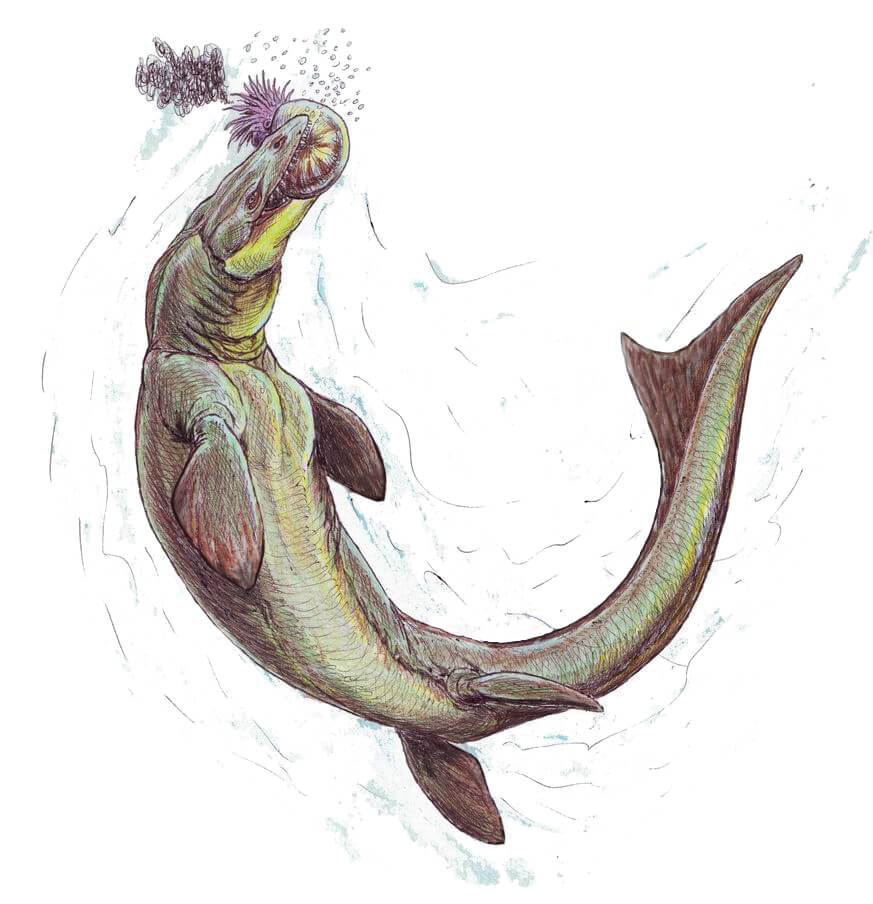
Artist's depiction of the mosasaur Prognathodon solvayi preying on an ammonite
Ammonites were fully marine animals, found all over the world's oceans, and typically lived in the upper few hundred metres of the water column rather than on the seabed. Some may have lived around cold seeps (areas where chemical-rich fluids leak from the seafloor). Their chambered shells gave them buoyancy, allowing them to float and move up and down in the water.
Their sharp, beaklike jaws and toothed radula (a kind of rasping tongue) let them seize and shred food. Small ammonites may have filtered plankton from the water, while larger ones likely preyed on crustaceans, molluscs, and small fish. At least one fossil shows remains of tiny isopods and mollusc larvae in its mouth.
They were important prey for many marine reptiles such as mosasaurs and ichthyosaurs, as well as some large fish. Fossil shells often show bite marks that match mosasaur jaws. Ammonites may also have squirted ink to escape predators, just like their modern cephalopod cousins.
Their sharp, beaklike jaws and toothed radula (a kind of rasping tongue) let them seize and shred food. Small ammonites may have filtered plankton from the water, while larger ones likely preyed on crustaceans, molluscs, and small fish. At least one fossil shows remains of tiny isopods and mollusc larvae in its mouth.
They were important prey for many marine reptiles such as mosasaurs and ichthyosaurs, as well as some large fish. Fossil shells often show bite marks that match mosasaur jaws. Ammonites may also have squirted ink to escape predators, just like their modern cephalopod cousins.
Extinction

Nautilus belauensis
Ammonites were still diverse and widespread right up to the end of the Cretaceous, but they disappeared during the mass extinction triggered by the Chicxulub asteroid impact 66 million years ago. The collapse of plankton populations, ocean acidification, and other upheavals of the impact winter likely combined to wipe them out.
A handful of fossil finds have been interpreted as ammonites surviving briefly into the earliest Paleocene (Danian stage), but most scientists think these are reworked specimens, meaning shells from older rocks that were redeposited in younger layers. As such, the prevailing view is that ammonites vanished at or immediately after the K–Pg boundary.
Several factors likely combined to doom ammonites - a collapse in plankton populations (their main food), harsher ocean conditions such as acidification that harmed their tiny, planktonic larvae, and major disruptions to marine ecosystems following the impact winter.
Their close relatives, the nautiluses, managed to endure. Scientists suggest this was because nautiluses laid larger eggs on the sea floor, lived in deeper waters less affected by the catastrophe, and had a more flexible reproductive strategy that helped them outlast the crisis.
A handful of fossil finds have been interpreted as ammonites surviving briefly into the earliest Paleocene (Danian stage), but most scientists think these are reworked specimens, meaning shells from older rocks that were redeposited in younger layers. As such, the prevailing view is that ammonites vanished at or immediately after the K–Pg boundary.
Several factors likely combined to doom ammonites - a collapse in plankton populations (their main food), harsher ocean conditions such as acidification that harmed their tiny, planktonic larvae, and major disruptions to marine ecosystems following the impact winter.
Their close relatives, the nautiluses, managed to endure. Scientists suggest this was because nautiluses laid larger eggs on the sea floor, lived in deeper waters less affected by the catastrophe, and had a more flexible reproductive strategy that helped them outlast the crisis.
References & Attributions
Image: Photograph of the ammonite Asteroceras which lived during the Jurassic - Dlloyd, CC BY-SA 3.0, via Wikimedia Commons
Image: Cross-section of an ammonite shell, showing the old chambers used for buoyancy; the animal itself lived only in the final, outermost chamber. - Linas Juozėnas, CC BY-SA 4.0, via Wikimedia Commons

Image: Polished ammonite shell showing intricate suture lines formed where the internal walls met the outer shell. - Amir Ali Iranshahi 3, CC0, via Wikimedia Commons

Image: Fossil of Titanites giganteus - Ghedoghedo, CC BY-SA 3.0, via Wikimedia Commons

Image: Parapuzosia seppenradensis, the largest known ammonite, with a diameter of 1.8m - Gunnar Ries, CC BY-SA 3.0, via Wikimedia Commons

Image: Fossil shell of Polyptychoceras - Hectonichus, CC BY-SA 3.0, via Wikimedia Commons

Image: Fossils of Nipponites mirabilis in the National Museum of Nature and Science, Tokyo. - Momotarou2012, CC BY-SA 3.0, via Wikimedia Commons

Image: Artist's depiction of the mosasaur Prognathodon solvayi preying on an ammonite - Dmitry Bogdanov, CC BY-SA 3.0, via Wikimedia Commons

Image: Nautilus belauensis - Manuae, CC BY-SA 3.0, via Wikimedia Commons
