Ankylosaurus
Dinosaur
Introduction

Life restoration of Ankylosaurus
Ankylosaurus was a large herbivorous ankylosaur - an "armored dinosaur" - that lived in what is now western North America during the Late Cretaceous period, approximately 68 to 66 million years ago. This was just before the asteroid impact that killed off the non-avian dinosaurs.
Currently, only one species is known: Ankylosaurus magniventris, first described in 1908. The name Ankylosaurus means "fused lizard," while magniventris translates to "great belly."
Although Ankylosaurus is the most well-known member of the ankylosaur group, it is actually known from only a handful of fragmentary remains. No complete skeleton has been discovered, so our understanding of this dinosaur is still limited compared to some other ankylosaurs.
Currently, only one species is known: Ankylosaurus magniventris, first described in 1908. The name Ankylosaurus means "fused lizard," while magniventris translates to "great belly."
Although Ankylosaurus is the most well-known member of the ankylosaur group, it is actually known from only a handful of fragmentary remains. No complete skeleton has been discovered, so our understanding of this dinosaur is still limited compared to some other ankylosaurs.
Size and Appearance
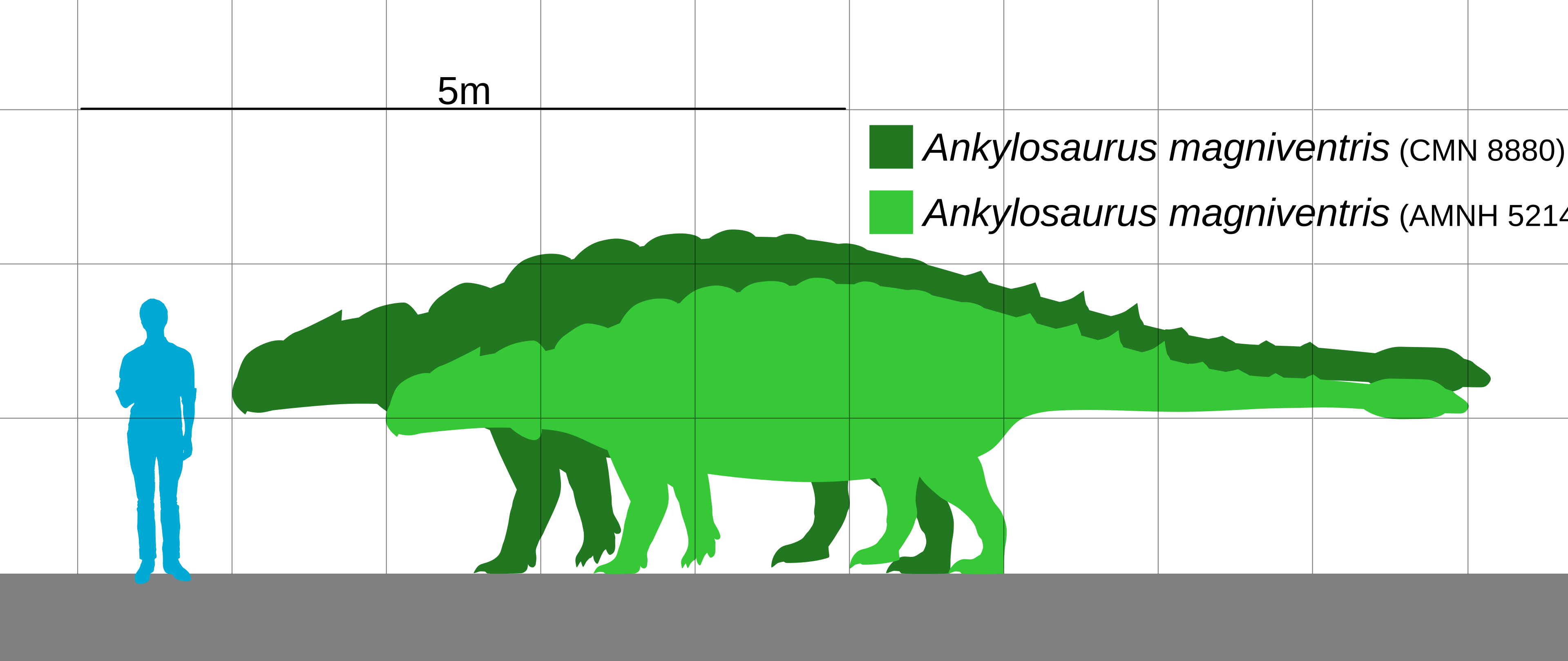
Size scale of Ankylosaurus
Ankylosaurus was likely one of the largest members of its group, with estimated lengths of about 6 - 8 m, standing 5.6 - 6 ft tall at the hips, and weighing up to around 8 tonnes.
The skull of Ankylosaurus was low, wide, and triangular, with a broad beak at the front for cropping plants. It was covered in bony plates and horns that likely fused to the skull as the animal matured, giving it a rough, armored appearance. The nostrils were set low and pointed downward and to the side, hidden from a head-on view and surrounded by extra bone, giving the snout a bulbous appearance.
Inside its mouth, Ankylosaurus had small, leaf-shaped teeth arranged in long, straight rows. Despite having over 70 teeth in the lower jaw alone, each tooth was tiny. These were shaped for cutting and grinding tough plants, and new teeth would replace worn-out ones.
The skull of Ankylosaurus was low, wide, and triangular, with a broad beak at the front for cropping plants. It was covered in bony plates and horns that likely fused to the skull as the animal matured, giving it a rough, armored appearance. The nostrils were set low and pointed downward and to the side, hidden from a head-on view and surrounded by extra bone, giving the snout a bulbous appearance.
Inside its mouth, Ankylosaurus had small, leaf-shaped teeth arranged in long, straight rows. Despite having over 70 teeth in the lower jaw alone, each tooth was tiny. These were shaped for cutting and grinding tough plants, and new teeth would replace worn-out ones.
Armor and Defense

One suggested arrangement of Ankylosaurus armor from 2017
One of the most distinctive features of Ankylosaurus was its armor, made up of large knobs and plates of bone — called osteoderms or scutes — embedded in the skin. These varied greatly in shape and size, from about 1 cm in diameter to around 35 cm long. The armor stretched from the neck, over the back, and along the tail, with additional protection provided by special half-rings of bone around the neck. Even the head was protected with bony plates, and sometimes extra bones above the eyes, offering defense against predators. The underside and possibly parts of the limbs were likely less armored.
Since these bones haven't been found in their original positions on a complete skeleton, scientists make educated guesses about their arrangement based on similar dinosaurs. In ankylosaurs, the armor plates were further strengthened by random bundles of collagen fibers built into the bone. This made the armor both lightweight and tough, capable of resisting bites from predators.
Since these bones haven't been found in their original positions on a complete skeleton, scientists make educated guesses about their arrangement based on similar dinosaurs. In ankylosaurs, the armor plates were further strengthened by random bundles of collagen fibers built into the bone. This made the armor both lightweight and tough, capable of resisting bites from predators.
Tail Club as a Weapon

Ankylosaurus tail club on display at the American Museum of Natural History
At the end of its tail, Ankylosaurus had a large, bony club used as a formidable weapon. The tail was stiffened by tendons, allowing it to deliver powerful swings, and studies suggest the club could hit with enough force to break the bones of large predators. Muscles in the back legs helped power these swings, enhancing the club's effectiveness. While adult Ankylosaurus could deliver bone-crushing blows, the clubs of juveniles were not strong enough to do this. Scientists are still unsure whether the tail club was used mainly for defense or for fights with other Ankylosaurus, but fossil evidence suggests it may have served both roles.
Movement and Skeleton
Much of the Ankylosaurus skeleton remains unknown, particularly the pelvis, tail, and feet. What is known shows that it walked on all fours, with its back legs longer than the front. Its shoulder and arm bones were short but very sturdy, and studies suggest the front limbs supported most of its weight and were built for powerful movements — possibly for digging or foraging. However, its hoof-like front feet would have limited its digging ability.Its backbone was adapted to support a heavy body, with strong ligaments and bones that helped hold up its massive, armored head. The ribcage was particularly wide, and some ribs were fused directly to the spine for added strength. Ankylosaurus was probably slow-moving most of the time but may have been capable of short bursts of speed.
Diet and Feeding

Outside and inside view of an Ankylosaurus tooth
As a plant-eater, Ankylosaurus had a wide mouth adapted for grazing on low-growing vegetation like ferns, shrubs, and possibly even fruit. It likely wasn't a picky eater, and some estimates suggest it may have needed to eat as much as a modern elephant does each day. Its beak and small, leaf-shaped teeth suggest it could handle a range of foods, possibly including roots, tubers, and even small invertebrates if dug up with its front limbs. Although it didn't chew its food thoroughly, it likely had a large gut to help digest tough plant matter.
Fossil Discoveries and Habitat
The first remains were discovered in the Hell Creek Formation in Montana. These remains were incomplete and did not include the dinosaur's now-famous tail club, which was found on a different specimen in 1910. While other ankylosaurs have been found on several continents, Ankylosaurus fossils have only been found in North America.Ankylosaurus lived during the very end of the Cretaceous Period, between 68 and 66 million years ago, in what is now North America. Most fossils have been found in ancient floodplain environments that bordered the Western Interior Seaway. This region had a warm, subtropical to temperate climate with seasonal rains and forested landscapes filled with flowering plants, conifers, ferns, and cycads.
Ecology
Ankylosaurus shared its habitat with a rich variety of other dinosaurs, including the horned Triceratops, the duck-billed Edmontosaurus, the dome-headed Pachycephalosaurus, and the giant predator Tyrannosaurus. Other animals included smaller plant-eating dinosaurs like Thescelosaurus, ostrich-like ornithomimids, and other armored dinosaurs such as Edmontonia, which may have occupied different habitats. Together, these species formed a vibrant and diverse Late Cretaceous ecosystem.References & Attributions
Image: Life restoration of Ankylosaurus - Sphenaphinae, CC BY-SA 4.0, via Wikimedia Commons
Image: Size scale of Ankylosaurus - User:Slate Weasel, Public domain, via Wikimedia Commons

Image: One suggested arrangement of Ankylosaurus armor from 2017 - Victoria M. Arbour, Jordan C. Mallon, CC BY 4.0, via Wikimedia Commons

Image: Ankylosaurus tail club on display at the American Museum of Natural History - Ryan Somma, CC BY-SA 2.0, via Wikimedia Commons

Image: Outside and inside view of an Ankylosaurus tooth - Barnum Brown, Public domain, via Wikimedia Commons
