Dilophosaurus
Dinosaur
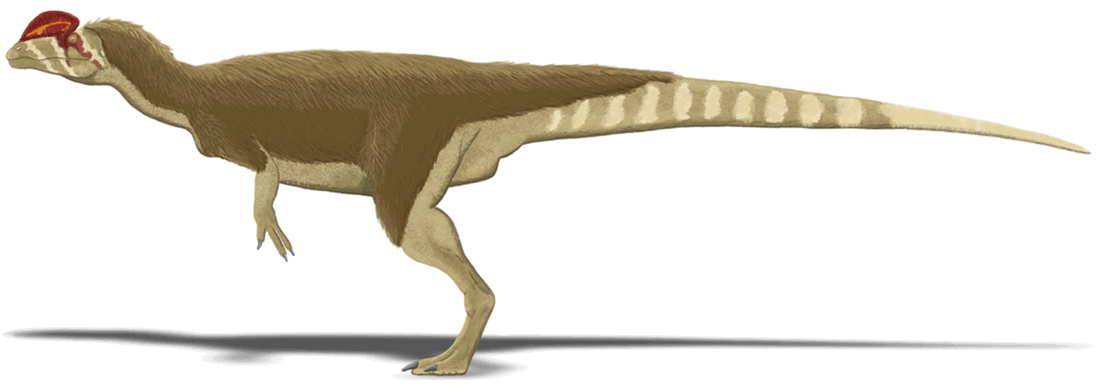
Dilophosaurus wetherilli life restoration
Dilophosaurus was a carnivorous, bipedal theropod dinosaur that lived during the Early Jurassic, around 185 million years ago, in what is now North America. Fossils have been found in Arizona. At the time, this region was a seasonally dry area where rivers created fertile, green oases with conifer trees, surrounded by dry sand dunes. The climate shifted between wet and dry periods.
Name and Popular Culture

Models showing Dilophosaurus as depicted in Jurassic Park

The frill-necked lizard on which the frill in Jurassic Park was based

An alert, ready to attack Mandalay spitting cobra
The name Dilophosaurus means "two-crested lizard," a reference to the two crests on its head. Many people may be familiar with the depiction of Dilophosaurus in Jurassic Park as a small, venom-spitting dinosaur with an expanding neck frill. However, while both of these features exist in modern animals, there is no evidence for either trait in Dilophosaurus. For example, the frilled lizard of Australia has a neck frill used to intimidate predators, and it is supported by skeletal structures. So while the frill itself would likely not be preserved, evidence of the supports would remain in fossils. Dilophosaurus was also the largest predator in its environment and would not have needed to ward off predators. Similarly, while some modern animals like cobras can spit venom and have specialized hollow teeth with venom glands, there is no evidence of such adaptations in Dilophosaurus. Currently, there is no known evidence of any dinosaur being venomous.
Size and Comparison

Size comparison of two Dilophosaurus specimens with a human
Additionally, and rather unusually for Jurassic Park, Dilophosaurus was actually much larger in real life - with the largest known specimen being around 7 m long, 1.8 m tall at the hips, and weighing around 400 kg. While not as large as later theropods like Tyrannosaurus rex or Spinosaurus, it was the largest known predator in North America during its time.
Discovery and Naming
Dilophosaurus was first discovered in 1942 by Charles L. Camp, a paleontologist from the University of California Museum of Paleontology. He discovered three specimens in the Kayenta Formation in Northern Arizona. Of these, one was almost complete, one was quite eroded but still included several important pieces such as the front of the skull (which was missing in the first specimen), jaws, vertebrae, and limb bones. The third was almost completely gone. A number of other specimens have since been found.Initially, it was thought to be a species of Megalosaurus and was given the name M. wetherilli. In 1970, it was given the name Dilophosaurus wetherilli.
Feathers: Evidence and Debate
It is not clear whether Dilophosaurus had feathers. Some trace fossils have been suggested to show evidence of feathers, but not all researchers agree; some argue that these impressions are actually artifacts caused by the dinosaur moving.Skull Structure and Crests

Dilophosaurus skull at the Royal Tyrrell Museum.
The skull of Dilophosaurus was large for its body size but relatively delicate and narrow, with a long, low shape and a rounded top. Unlike the blunt, rounded snout seen in movies, the real animal's snout was quite elongated and slender. Its most striking feature was a pair of thin, arching crests running along the top of the skull. These crests were made of fused bone and likely covered in keratin, which could have made them appear even larger in life. While it is not entirely certain what the crests were for - suggestions have included display, species recognition, and thermoregulation - the prevailing theory is that they were a display structure to attract mates.
Another unique aspect of Dilophosaurus's skull was a noticeable notch or gap - called a "subnarial gap" or diastema - between the bones at the front of the upper jaw (the premaxilla) and the main upper jaw bone (the maxilla). This gap gave the dinosaur a kind of hook-nosed, snaggle-toothed look and is thought to have resulted in a relatively weak bite compared to other meat-eaters. The jaws were likely best at grabbing and holding smaller prey, perhaps even fish, with long, curved, and somewhat widely spaced teeth. The overall impression is of an animal specialized for snatching rather than crushing, with a skull built more for speed and precision than for brute strength.
Another unique aspect of Dilophosaurus's skull was a noticeable notch or gap - called a "subnarial gap" or diastema - between the bones at the front of the upper jaw (the premaxilla) and the main upper jaw bone (the maxilla). This gap gave the dinosaur a kind of hook-nosed, snaggle-toothed look and is thought to have resulted in a relatively weak bite compared to other meat-eaters. The jaws were likely best at grabbing and holding smaller prey, perhaps even fish, with long, curved, and somewhat widely spaced teeth. The overall impression is of an animal specialized for snatching rather than crushing, with a skull built more for speed and precision than for brute strength.
Body Structure and Locomotion
The rest of Dilophosaurus's body was built for agility and speed, with a long, flexible neck supported by light, hollow vertebrae filled with air sacs - making it both strong and lightweight. Its body had 14 back vertebrae and a very long tail made of 45 vertebrae that likely helped with balance while running or turning. The arms were strong and muscular, ending in hands with four fingers, including a large claw on the innermost finger for grasping prey. Its shoulder blades were broad and distinctive, and the hind legs were long and powerful, built for fast movement, with large, three-toed feet sporting sharp claws. The pelvis was sturdy, and the legs were shaped for running, with the massive thigh bone (femur) being slightly longer than the lower leg bone (tibia), giving Dilophosaurus a characteristic, athletic dinosaur build.The best current evidence suggests that Dilophosaurus was a fast, agile dinosaur. Its long, strong legs, lightweight skeleton, and stiffened tail would have made it an efficient runner, able to chase down prey. Its hands faced inward towards each other (not downwards), making them useful for grasping, but the animal's main contact with prey likely came from its jaws rather than its arms. While earlier suggestions imagined Dilophosaurus using its arms for slashing or even swimming, more recent work finds its hands best suited for seizing smaller prey or manipulating objects close to its chest.
Trackways, Behavior, and Social Life
Trackways and fossil "resting poses" from the Early Jurassic match what we know of Dilophosaurus, and while we can't be 100% certain, it's very likely that they were made by this dinosaur or a close relative. They indicate that Dilophosaurus could crouch similarly to modern birds, resting with its weight on its feet, metatarsals, and hips, while keeping its tail elevated. Its forelimbs were flexible enough for grasping and holding, but their range of motion suggests they were less important for locomotion or digging, and more for helping secure food or during displays. It may also have traveled in small groups, though definitive evidence for pack behavior is still debated and very hard to determine from the fossil record.What Did it Eat?
Dilophosaurus was likely an opportunistic predator and scavenger, with a diet that included whatever prey was available. Its long, slender jaws and curved teeth were well-suited for grabbing and slicing smaller animals, and several features suggest it may have hunted fish as well. The tip of its snout was expanded into a "rosette" of interlocking teeth - similar to modern fish-eating crocodilians - which is ideal for catching slippery prey. Its nostrils were set farther back on the skull, possibly to help keep water out while fishing, and its strong, clawed arms could have helped snatch prey from the water. Although earlier researchers thought it had a weak bite and might have relied mostly on scavenging, more recent studies indicate Dilophosaurus had jaws strong enough to take on larger animals. Overall, Dilophosaurus probably ate anything it could catch or find, from small vertebrates and fish to the remains of larger dinosaurs.Where it Lived: The Kayenta Formation
Dilophosaurus fossils are found in the Kayenta Formation, which consists of ancient riverbeds and sand dunes spread across parts of Arizona, Utah, Colorado, and New Mexico. The area was seasonally dry, with stretches of sandy desert and rivers bordered by conifer trees and other vegetation. Sometimes, sand dunes from the nearby Navajo desert would move into these river environments, resulting in a landscape with both wet and dry areas.The Kayenta Formation contained a variety of animal and plant life. The rivers and lakes were home to bony fish, lungfish, freshwater clams, snails, salamanders, and frogs. On land, there were conifers and other plants, as well as turtles, lizards, early crocodile relatives, and small mammals. Dinosaurs were also present, including other theropods, early plant-eating dinosaurs such as Sarahsaurus and Scutellosaurus. This environment provided Dilophosaurus with several potential prey animals and a habitat that changed with the seasons.
References & Attributions
Image: Dilophosaurus wetherilli life restoration - Leandra Walters, published by Phil Senter and James H. Robins, CC BY 2.5, via Wikimedia Commons
Image: The frill-necked lizard on which the frill in Jurassic Park was based - Matt from Melbourne, Australia, CC BY 2.0, via Wikimedia Commons
%20(8692622586).jpg)
Image: An alert, ready to attack Mandalay spitting cobra - MorphinESTP, CC BY-SA 4.0, via Wikimedia Commons
%202.jpg)
Image: Size comparison of two Dilophosaurus specimens with a human - SlvrHwk, CC BY-SA 4.0, via Wikimedia Commons

Image: Dilophosaurus skull at the Royal Tyrrell Museum. - Sebastian Bergmann from Siegburg, Germany, CC BY-SA 2.0, via Wikimedia Commons

Image: Models showing Dilophosaurus as depicted in Jurassic Park - Tomás Del Coro, CC BY-SA 2.0, via Wikimedia Commons
