Major Groups of Dinosaurs


Dinosaurs are most commonly defined as the most recent common ancestor of Triceratops and modern birds, and all its descendants. They are generally divided into two main groups based on how their hip bones are arranged - the Ornithischians ("bird-hipped") and the Saurischians ("lizard-hipped"). Rather interestingly (or confusingly) we now know that birds actually evolved from the "lizard-hipped" saurischian group and then later evolved a hip bone arrangement similar to that of Ornithischian dinosaurs. This is an example of convergent evolution - where similar features evolve independently in different species or at different times.
The hip contains an upper bone called the ilium, and beneath this are the ischium and the pubis. In Ornithischian dinosaurs, the pubis points backwards - towards the tail of the animal. In some cases there is a forward-facing projection from the pubis, but this is generally small. In saurischian dinosaurs, the pubis points forwards towards the front of the animal. Another feature of Ornithischian dinosaurs is the presence of a "beak-forming" bone called the predentary in their lower jaw.Saurischians
Sauropodomorphs


The heads of sauropods were generally quite small relative to their size, often with weak peg-like teeth - suggesting they did not orally process their food. This helped to reduce the weight of the head, allowing the neck to get longer and helping them reach taller vegetation. Essentially, the teeth were just used to strip leaves off plants - and they relied on their gut to process the food.
Some sauropods have also been found to have body armor, such as Shunosaurus - a sauropod from the late Jurassic which had a tail club with 2 spikes, and Saltasaurus - a sauropod from the late Cretaceous which had bony osteoderms along its back. Like modern birds, sauropods had hollow bones.
Theropods

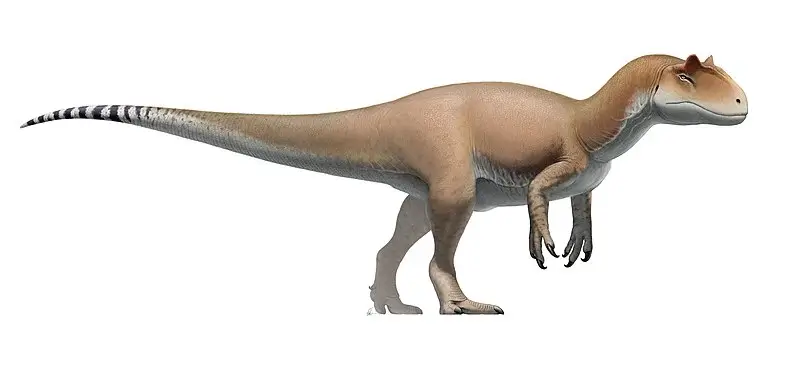


Theropods were bipedal dinosaurs including well-known carnivores like Allosaurus, Tyrannosaurus Rex and Giganotosaurus. The name theropod means "beast-footed". Theropods generally had short arms that ended with 2 or 3 claws, and also had hollow bones like modern birds. Most theropods had very sharp, serrated teeth.
A number of theropod species have been discovered with evidence of feathers - ranging from simple hair-like filamentous "protofeathers" to much more complex feathers like the long tail feathers of Epidexipteryx. While most theropod species were carnivores, some theropod species have been found to have been herbivores, omnivores, insectivores or piscivores (fish-eaters).
Theropods ranged in size from small animals weighing only a few hundred grams to enormous carnivores like Tyrannosaurus Rex, and some are likely flying above your head as you read this - this is the group that modern birds are descended from.Ornithischians
The Ornithischians can be further divided into 5 main groups - the stegosaurs, the ankylosaurs, the ceratopsains, the pachycephalosaurs and the ornithopods.
Stegosaurs


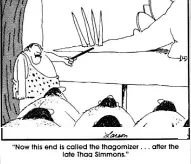
The distinctive arrangement of the 4 tail spikes in Stegosaurs is semi-formally referred to as a "Thagomizer". This term was initially coined by a "Far Side" cartoon in which a caveman is seen pointing to a slide with an image of a stegosaurus tail and saying "This end is called the thagomizer... after the late Thag Simmons" (presumably another caveman in the group who had an unfortunate encounter with those spikes). The term has since been adopted by a number of paleontologists and institutions.
The exact function(s) of the plates on the backs of Stegosaurian dinosaurs has been a subject of much debate. Suggested functions have included display, thermoregulation and defense. While the thermoregulation theory is often stated in popular books etc., probably the most endorsed theory by paleontologists today is that they were primarily used for display. However, this is not certain - and being large structures on their body it is certainly possible that they had some thermoregulatory effect. The plates varied significantly between different stegosaur species - with some species having smaller, narrower plates and others such as Kentrurosaurus having plates along only part of the back. These variations meant that some species had plates which were not optimized for thermoregulation, and would seem to support the theory that they were for display and species recognition.
Ankylosaurs

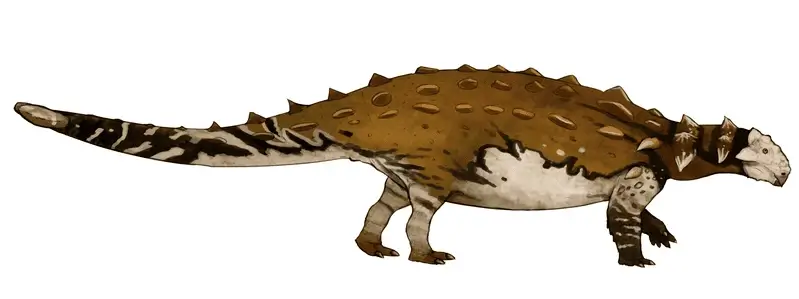
Like stegosaurs, the front legs of ankylosaurs were shorter than their rear legs - though this difference is generally less pronounced in ankylosaurs. Some ankylosaurs, like the famous Ankylosaurus, also had a large bony club at the end of their tail. Ankylosaurs and Stegosaurs both belong to a larger group of armored dinosaurs called Thyreophora. Ankylosaurs likely fed on low-lying plants such as cycads, ferns, and angiosperms (flowering plants).
Ceratopsians


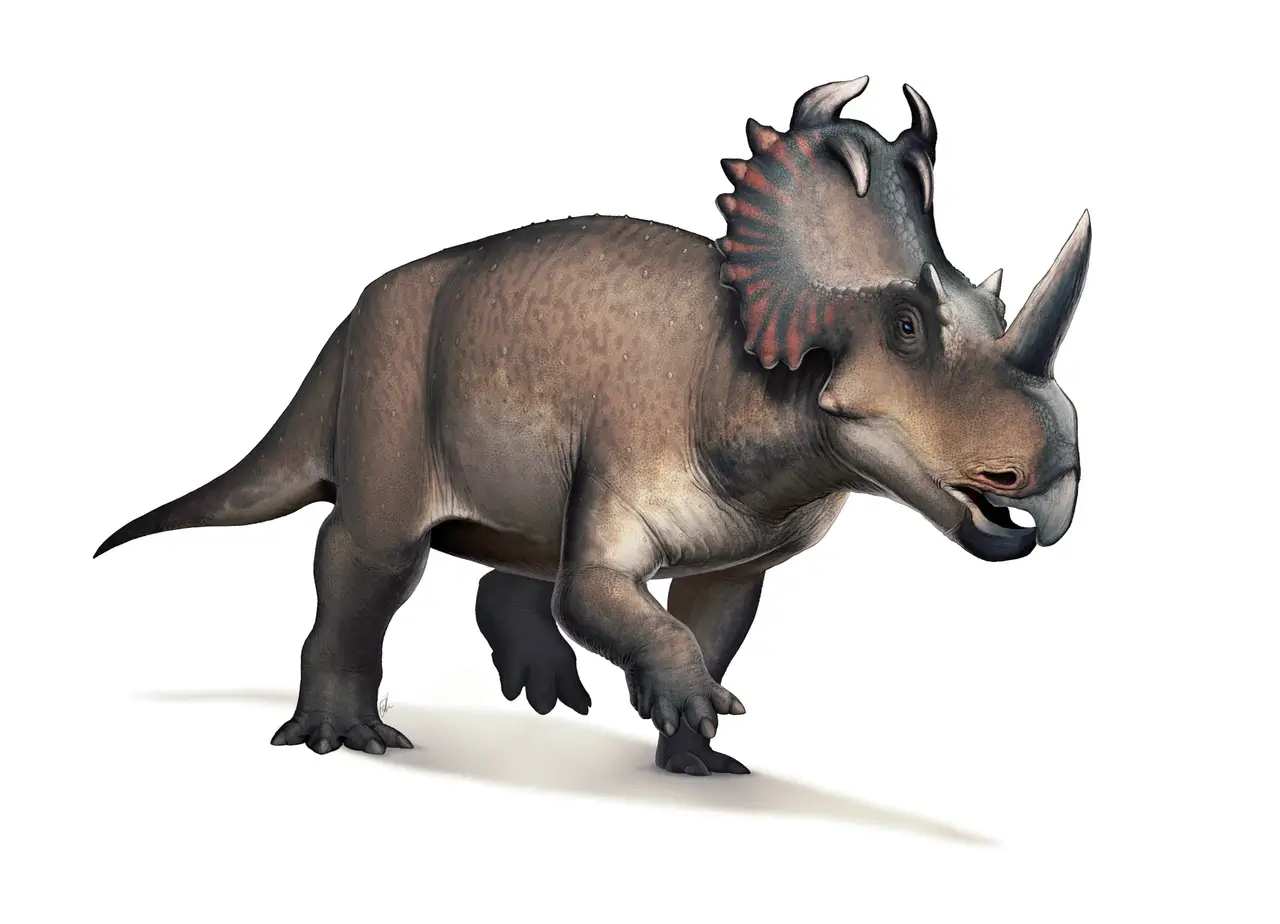


The next group is the Ceratopsians - these dinosaurs had parrot-like beaks and often had large neck frills (though this feature is absent in some members). Some earlier ceratopsians were bipedal, with the later, larger members being quadrupeds. The most well-known member of this group is Triceratops - this was one of the largest ceratopsians, and lived until the mass extinction at the end of the Cretaceous period. Large horns were common among ceratopsians, and many had dental batteries for grinding vegetation.
While many people might only be familiar with Triceratops, the frills and horns of ceratopsians were spectacularly diverse - as shown in the images here. Many people assume that the frills on ceratopsians were mainly intended for protection, but it is thought that they were actually primarily display structures. Triceratops is actually unusual in having a solid, thick frill - many other ceratopsian frills were thinner with holes (fenestrae) in them, and they were ornamented with bony extensions called epossifications.
Many species of ceratopsian dinosaurs have names that end in "ceratops" but this is not always the case - for example Psittacosaurus and Centrosaurus are both ceratopsian dinosaurs.Ornithopods
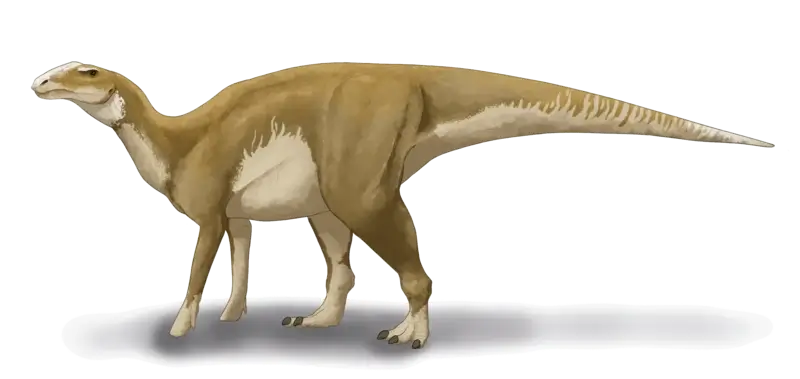

It is thought that most Iguanodonts were probably facultative bipeds - which means that they walked on all fours most of the time but could move on just their hind limbs at times, such as when running or eating taller vegetation.
Pachycephalosaurs

References & Attributions
Image: Ornithischia Pelvis - AdmiralHood, CC BY-SA 3.0, via Wikimedia Commons
Image: Saurischia Pelvis - AdmiralHood, CC BY-SA 3.0, via Wikimedia Commons

Image: Stegosaurus Stenops Restoration - Fred Wierum, CC BY-SA 4.0, via Wikimedia Commons

Image: Huayangosaurus Restoration - Nobu Tamura (http://spinops.blogspot.com), CC BY 3.0, via Wikimedia Commons

Image: Thagomizer - Wikimedia. We believe our use of this image qualifies as fair use for the same reasons as outlined by Wikipedia: It is a low-resolution scan of a single comic strip. Its reproduction here will not significantly impact the copyright holder's ability to profit from his copyright, as this is only one strip, published in books which include hundreds of strips. It is being used for informational purposes only, not for profit. Its use significantly enhances the article, since the term "Thagomizer" was coined in this particular comic strip, and the image is included in order to illustrate that point.

Image: Anklyosaurus Restoration - Sphenaphinae, CC BY-SA 4.0, via Wikimedia Commons

Image: Talarurus Restoration - Jack Mayer Wood, CC BY-SA 4.0, via Wikimedia Commons

Image: Triceratops Restoration - Connor Ashbridge, CC BY-SA 4.0, via Wikimedia Commons

Image: Kosmoceratops Restoration - Nobu Tamura, CC BY-SA 4.0, via Wikimedia Commons

Image: Styracosaurus Restoration - Nobu Tamura (http://spinops.blogspot.com), CC BY 3.0, via Wikimedia Commons

Image: Psittacosaurus Restoration - Petr Menshikov (https://twitter.com/Petr75113553; https://vk.com/prehistoricproduction), CC BY-SA 4.0, via Wikimedia Commons

Image: Centrosaurus Restoration - Fred Wierum, CC BY-SA 4.0, via Wikimedia Commons

Image: Triceratops Scale - User:Slate Weasel, Public domain, via Wikimedia Commons

Image: Allosaurus Restoration - Fred Wierum, CC BY-SA 4.0, via Wikimedia Commons

Image: Epidexipteryx Restoration - Nobu Tamura, CC BY-SA 3.0, via Wikimedia Commons

Image: Tyrannosaurus Skeletal Reconstruction - Scott A. Hartman, CC BY 4.0, via Wikimedia Commons

Image: Theropod Size Scale - KoprX, CC BY-SA 4.0, via Wikimedia Commons

Image: Massospondylus Restoration - Nobu Tamura (http://spinops.blogspot.com), CC BY 3.0, via Wikimedia Commons

Image: Shunosaurus Restoration - User:Smokeybjb (Edits by User:Paleocolour), CC BY-SA 3.0, via Wikimedia Commons

Image: Sauropod Scale - KoprX, CC BY-SA 4.0, via Wikimedia Commons

Image: Iguanodon Skeletal Reconstruction - Slate Weasel, CC BY-SA 4.0, via Wikimedia Commons

Image: Hadrosaurus Restoration - Audrey.m.horn, CC BY-SA 4.0, via Wikimedia Commons

Image: Pachycephalosaurus Restoration - DataBase Center for Life Science (DBCLS), CC BY 4.0, via Wikimedia Commons
