Stegosaurus
Stegosaurus shared its ecosystem with a diverse range of prehistoric life. Among its contemporaries were predators like Allosaurus (which likely preyed on it), Ceratosaurus, and Saurophaganax. Large sauropods such as Diplodocus and Brachiosaurus roamed the same terrain, along with other herbivores like Camptosaurus and Nanosaurus. Other creatures included snails, turtles, frogs, early mammals, crocodylomorphs (ancestors of crocodiles), and pterosaurs (flying reptiles often mistakenly called "pterodactyls").
Discovery and the "Bone Wars"
Stegosaurus was first discovered in the 1800s, with paleontologist O.C. Marsh first describing it in 1877. It was discovered during the famous "Bone Wars"—a period of fierce competition between Othniel Charles Marsh and Edward Drinker Cope to find and name dinosaur fossils. While they both took the competition too far at times—resorting to underhanded tactics including bribery, theft, and spreading misinformation—the intense rivalry ultimately led to many new discoveries.Species of Stegosaurus

There are currently three generally accepted species of Stegosaurus:
- S. stenops (meaning "narrow-faced roof lizard")
- S. ungulatus ("hoofed roof lizard")
- S. sulcatus ("furrowed roof lizard")
Size and Movement
Stegosaurus ranged from around 6 - 9 m long, up to around 4 m tall, and weighed around 3.5 - 4 tonnes. It was quadrupedal, though some paleontologists have suggested it may have been able to rear up on its hind legs at times to reach taller vegetation. It likely did not move very fast as it had very short front legs - shorter than the back legs - which would have limited its speed. Current estimates range from around 15 - 18 km/h.Head, Brain, and Diet
Stegosaurus' head was proportionally quite small and narrow, with a toothless turtle-like beak in the front and small, leaf-shaped teeth at the back. The braincase was famously small for a dinosaur of its size - about the size of a golf ball, similar to the size of a dog's brain. This sometimes leads people to question how Stegosaurus even survived, but there are some important points to note here. First, brain size is not the only factor that determines intelligence. Second, as humans, we often value our own intelligence very highly and underestimate that of other animals, or overlook abilities or types of intelligence that we do not possess. Stegosaurus, like many animals, was perfectly suited to its environment without needing a large brain.Exactly how Stegosaurus managed to eat and process the amount of food they needed for their large size is still not well understood. They had very small teeth - only a few millimeters across - not well-adapted for grinding vegetation. Their jaws appear to have been limited to moving up and down like scissors, and there is no evidence that they used gastroliths (gizzard stones) to grind their food like birds and some other dinosaurs did. Bite force estimates vary, with more recent estimates putting it on par with that of modern cattle and sheep.
The Famous Back Plates

Along its back, Stegosaurus had close to 20 large, flat, triangular plates. These plates were osteoderms (bones which develop in the skin) and could reach sizes of around 60 cm in length and width. The exact function(s) of the plates on the backs of stegosaurian dinosaurs has been a subject of much debate. Suggested functions have included display, thermoregulation, and defense. While the thermoregulation theory is often stated in popular books, the most endorsed theory by paleontologists today is that they were primarily used for display. However, this is not certain—and being large structures on their body, it is certainly possible that they had some thermoregulatory effect.
The Thagomizer: Stegosaurus' Tail Weapon
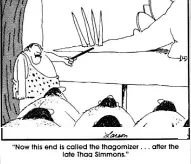
Moving down to the tail, Stegosaurus had four large tail spikes, each around 60-90 cm long. While these spikes are often depicted as sticking up vertically, we now know that they stuck out horizontally to the side - an orientation that made them far more useful for defense. The distinctive arrangement of the four tail spikes in Stegosaurus is semi-formally referred to as a thagomizer. This term was initially coined by a "Far Side" cartoon in which a caveman is seen pointing to a slide with an image of a Stegosaurus tail and saying, "This end is called the thagomizer... after the late Thag Simmons" (presumably another caveman in the group who had an unfortunate encounter with those spikes). The term has since been adopted by a number of paleontologists and institutions. It is thought that these spikes were mainly used to defend against predators like Allosaurus.
Still More to Discover
Despite being one of the most well-known dinosaurs, and with several well-preserved specimens, there is still much to learn about Stegosaurus, from the exact function of its plates to the details of its behavior, growth, and interactions with other dinosaurs. As new discoveries are made and technology advances, our understanding of this fascinating Jurassic herbivore will continue to evolve.References & Attributions
Image: Size comparison of S. ungulatus (orange) and S. stenops (green) with a human - KoprX, CC BY-SA 4.0, via Wikimedia Commons
Image: Life Restoration of S. stenops, showing the back plates and thagomizer - Fred Wierum, CC BY-SA 4.0, via Wikimedia Commons

Image: Thagomizer - Wikimedia. We believe our use of this image qualifies as fair use for the same reasons as outlined by Wikipedia: It is a low-resolution scan of a single comic strip. Its reproduction here will not significantly impact the copyright holder's ability to profit from his copyright, as this is only one strip, published in books which include hundreds of strips. It is being used for informational purposes only, not for profit. Its use significantly enhances the article, since the term "Thagomizer" was coined in this particular comic strip, and the image is included in order to illustrate that point.